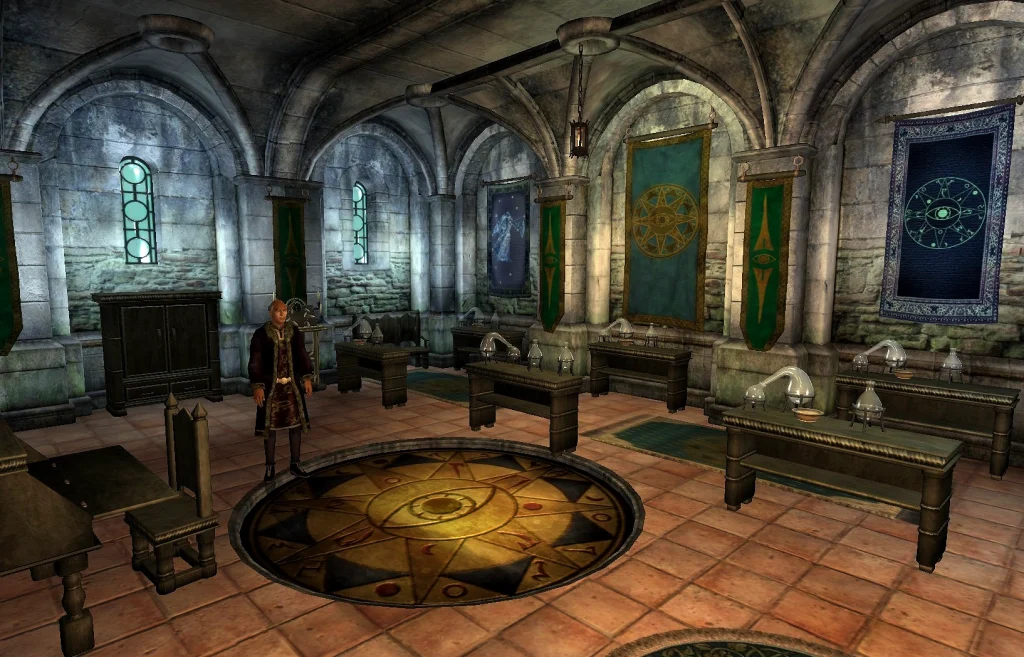
The Arcane University in The Elder Scrolls IV: Oblivion serves as the central headquarters of the Mages Guild in the Imperial City, and it is laid out as a connected campus of separate buildings rather than a single interior space. Instead of one continuous dungeon-like structure, it functions more like a small academic district, where each tower or hall is physically distinct but tied together through a central courtyard. This design makes navigation feel more like moving between departments in a real institution rather than progressing through a linear building.
Each section of the university is dedicated to a specific function of magical study and guild administration, and access to certain areas is restricted based on guild rank and quest progression. This creates a clear sense of hierarchy inside the institution, where higher-level members gain entry to more important facilities over time. The layout reinforces the idea that the Arcane University is not just a place to learn magic, but the operational center of the entire Mages Guild across Cyrodiil.
Locations of Interest
The central courtyard is the main hub area of the Arcane University, an open stone space that connects all the surrounding towers and buildings. It contains the primary entrances to each guild facility and later becomes the access point for the guild teleportation network that links all Mages Guild halls across Cyrodiil, making it the main navigation center of the entire university.
The Mystic Archives is the guild’s library and research wing, filled with rows of bookshelves, skill books, and magical lore that supports both worldbuilding and quest progression. Certain sections are locked behind guild rank, and it functions as the primary knowledge storage area for magical study within the Mages Guild.
The Chironasium is the functional core of mage progression, containing the spellmaking altar and enchanting altar. This is where custom spells are created and enchantments are applied to gear, making it the most mechanically important room for developing a mage character and unlocking advanced magical builds.
The Arch-Mage Tower is the administrative and endgame section of the university, containing the Arch-Mage’s quarters, storage, and quest-related spaces. It becomes fully accessible after completing the Mages Guild questline and serves as the player’s official base of operations within the guild hierarchy.
What You Actually Do Inside Of It
Inside the Arcane University in The Elder Scrolls IV: Oblivion, the experience is centered around progression systems that turn magic from something you use into something you actively build and refine over time. The main gameplay loop is about increasing your mage rank through the Mages Guild, which unlocks new permissions, stronger magical tools, and access to higher-level crafting systems that fundamentally change how you play a mage character.
A large part of what you actually do is tied to custom spell creation and enchantment systems. Instead of relying only on pre-made spells, you start combining effects into personalized builds, adjusting power, duration, and cost based on your character’s skill progression. This is where mage gameplay becomes flexible, because your power is no longer just what you find—it becomes what you design.
Another major part of the experience is progression through guild structure itself. Advancement isn’t automatic; it is tied to completing recommendations and proving your ability across different cities before being recognized at the University level. This creates a sense that your access to magical knowledge is earned rather than freely given, and each rank increase noticeably expands what systems you can use and what spells you can realistically build.
There is also a long-term loop built around optimization and resource management. Soul gems, spell effects, and gear upgrades become interconnected systems that push you toward planning your character instead of just casting randomly in combat. As your abilities scale, you start to rely less on basic spells and more on crafted combinations that fit your playstyle, which is where the Arcane University becomes the core engine of mage progression.
By the time you are fully integrated into the system, the Arcane University is no longer just a location you visit for upgrades—it becomes the framework that defines how your entire mage character functions in the world.
Roleplaying as a Mage Inside the Arcane University
A big part of the Arcane University in The Elder Scrolls IV: Oblivion is that it supports roleplaying without needing mechanics to force it. Once you are part of the Mages Guild, the environment naturally lets you act like a full-time mage rather than just an adventurer who occasionally casts spells.
One of the simplest roleplaying elements is just how you structure your daily routine inside the guild. You can treat the university like a living institution—starting your day by studying in the guild spaces, practicing spells, or checking books and scrolls in the archives before heading out to complete quests. Even though the game doesn’t enforce schedules, the layout and atmosphere make it easy to imagine a consistent “mage routine” where learning and experimentation come first, and exploration happens afterward.
Interaction with other mages also reinforces this roleplay structure. The guild is filled with NPCs who are already embedded in their own roles as researchers, apprentices, and senior mages, which makes simple conversations feel like part of a working institution. You can talk to them between tasks, hear repeated lines that still fit the idea of a functioning guild, and treat them like coworkers rather than random NPCs, which strengthens the feeling that you are part of something organized.
Even basic survival actions like resting or eating (when roleplaying it manually) can be framed around guild life. You can return to your quarters, imagine downtime between experiments, or treat recovery periods as time spent away from magical study. The game doesn’t simulate these needs directly, but the structure of the Arcane University makes it easy to roleplay a cycle of work, study, and rest inside a single location.
Over time, this turns your character into something more defined than just a class build. Instead of “a player using magic,” you start behaving like a member of a functioning magical order, where your actions feel tied to an institution, not just personal progression.
What Makes Arcane University So Special
What makes the Arcane University in The Elder Scrolls IV: Oblivion stand out isn’t one single feature—it’s how all of its systems, spaces, and progression layers combine into a single identity for the Mages Guild. It is not just a location you unlock late in the game, but the point where the entire mage experience becomes structured, centralized, and fully realized.
It changes the way magic feels because it turns it into something organized rather than random. Spellmaking, enchanting, rank progression, and guild access all connect into one system that gradually builds your character into a defined role within the world. Instead of being a wandering adventurer who uses magic, you become part of an institution that studies, refines, and controls it.
It also stands out because of how it is paced. You don’t enter the Arcane University immediately—you earn it through smaller guild halls and recommendations across Cyrodiil. That slow unlock process makes the final location feel like a reward that represents your entire journey rather than just another quest marker.
In the end, the Arcane University works because it feels complete in a way most locations in the game don’t. It has structure, purpose, and progression built directly into its design, and once you’re inside it, the rest of your mage playthrough naturally revolves around it. It becomes the place where your build, your story, and your identity as a mage all come together in one system.